
QC for a Niche Brand on a Small Lot: What the Factory Does, What You Do
A niche brand ordering a small haircare lot usually cannot justify a quality department, and does not need one. What it needs is a clear picture of which checks the factory performs as part of its own system and which ones nobody performs unless the brand asks. Assuming a certified factory covers everything is a mistake, and trying to duplicate its laboratory is a bigger one. Between those two positions sits a short list of checks a two-person brand can genuinely run.
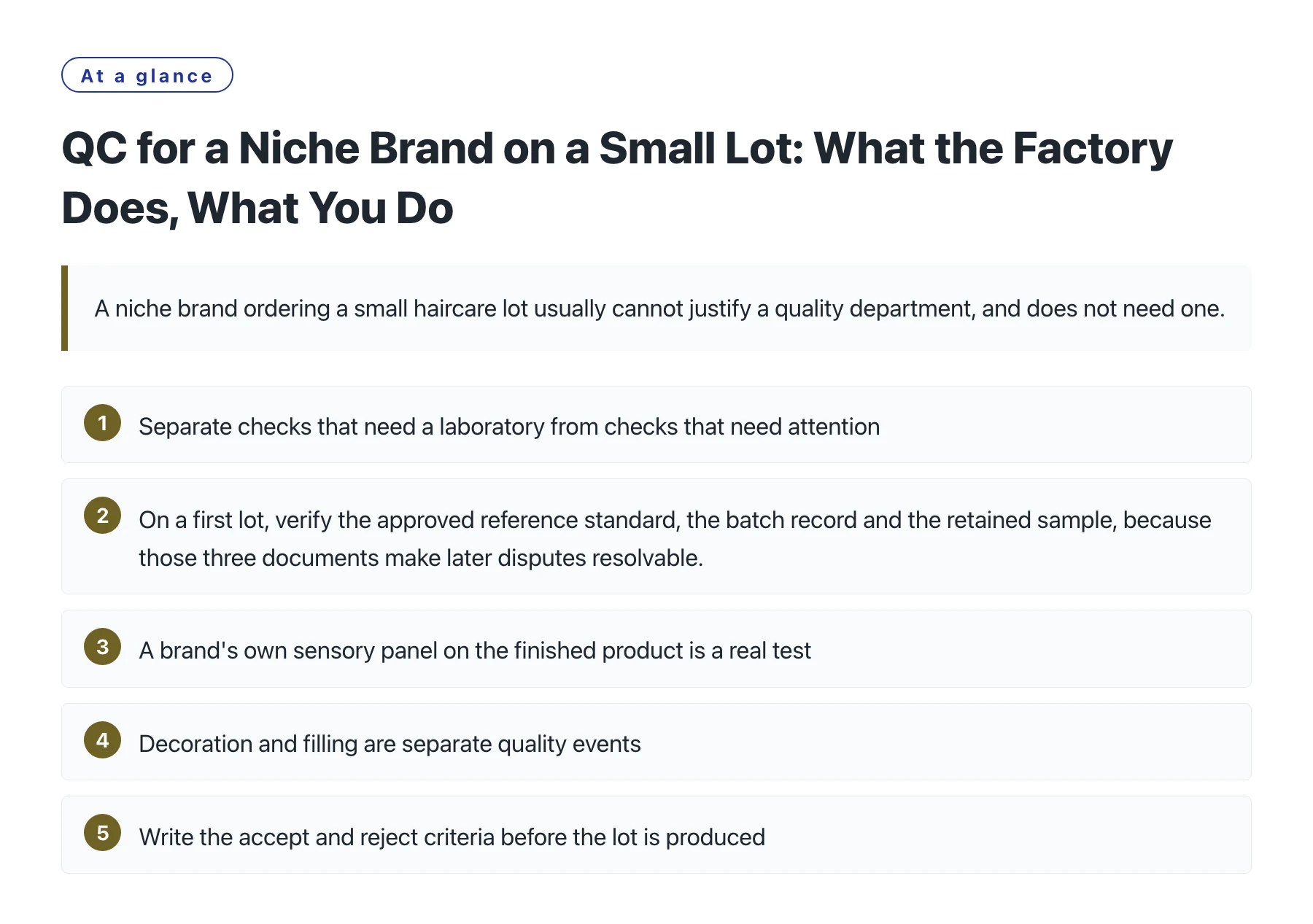
Key takeaways
- Separate checks that need a laboratory from checks that need attention; the second group is what usually protects a small lot.
- On a first lot, verify the approved reference standard, the batch record and the retained sample, because those three documents make later disputes resolvable.
- A brand's own sensory panel on the finished product is a real test, and it is one the factory cannot run on the brand's behalf.
- Decoration and filling are separate quality events, so flawless print on a badly handled bottle is still a reject.
- Write the accept and reject criteria before the lot is produced, so the decision is not made by mood on delivery day.
Working with an OEM is how most niche perfume brands reach the market without owning a factory, and it works well, provided the brand understands what it has and has not bought. A manufacturing partner brings process control, documentation and testing capability. It does not bring the brand's taste, and it does not automatically apply it.
The practical question for a small brand is not how to build a quality system. It is which three or four checks, done consistently, would catch the failure that would actually hurt.
This guide splits those checks by who can realistically perform them, and sets out the routine that fits a small team.
Two kinds of check, and why the distinction matters
The first kind of check needs equipment: microbial testing, stability chambers, analytical verification of a fragrance compound, migration or compatibility testing on packaging. A niche brand will not run these, and should not try. They belong to the manufacturer or to an independent laboratory, and the brand's job is to confirm that they were performed and to keep the report.
The second kind of check needs attention rather than equipment. Does the bulk smell like the approved reference? Is the fill volume where it should be? Is the print aligned and the cap seated? Do the units from the beginning, middle and end of the run look the same? These checks require a standard, a light box, a scale and thirty minutes of discipline, and they catch a large share of the problems that reach a small brand.
Confusing the two categories leads to bad spending. A founder who pays for laboratory testing on a decoration issue has bought the wrong evidence. A founder who relies on the factory's certificate but never compares the bulk against the reference has skipped the cheapest check available.
Who checks what on a small haircare lot
| Check | Who can do it | Evidence it produces | What happens if it is skipped |
|---|---|---|---|
| Formulation and safety verification | Manufacturer or independent laboratory | Test reports and compliance documents | The brand has no defensible record for the formula |
| Restricted-material check against IFRA standards | Manufacturer, reviewable by the brand | A statement of restricted materials and their limits | Reformulation risk surfaces after the launch |
| Comparison against the approved reference | Brand, using a sealed reference sample | A dated sensory record | Drift is discovered by customers instead of the brand |
| Fill volume and closure integrity | Manufacturer, spot-checked by the brand | Line records plus the brand's own spot check | Leaks and short fills become returns |
| Decoration appearance and location | Brand at first-off and at delivery | Approved first-off units and a delivery inspection note | Off-print or misplaced decoration ships |
| Retained sample from the bulk run | Manufacturer, requested in writing by the brand | A sealed, dated sample held for the shelf life | Nothing to compare a later complaint against |
Only two rows in this table require the brand to act. Those are the two that most small brands omit.
The three documents that make disputes resolvable
Most quality disputes on a small lot are not arguments about facts; they are arguments about standards. The approved reference sample settles what the product was supposed to smell and look like. The batch record settles what was actually made and when. The retained sample settles what was in the bottle if a question arrives a year later.
Restricted-material limits are the other place where a brand needs its own copy of the reasoning. The IFRA Standards Library sets out which materials carry use restrictions and by product category [1], which is why a haircare formulation and a fine fragrance formulation with the same accord can end up with different ceilings. Asking which materials in your formula are restricted, and how much headroom each has, is a question a small brand can reasonably put to any partner.
The fragrance industry also has a visible public side that is useful for a founder learning the vocabulary. The Fragrance Foundation is the sector's industry organisation and publishes material aimed at professionals and the public [2], which makes it a reasonable starting point before a technical conversation.
Independent laboratories are the third leg of this. Global testing companies list cosmetics, personal care and household testing among their service lines [3], including packaging and print performance, so a brand that wants an outside opinion on a contested batch has somewhere to go.
A brand-side routine that fits a small team
- Keep a sealed reference sample in the darkStore the approved sample away from light and heat, label it with the date and the batch it came from, and treat it as the standard rather than as a souvenir.
- Build a one-page inspection sheetSmell, fill, closure, print placement and general appearance, with a pass and fail column. Five lines beat a blank page, because a blank page invites improvisation.
- Inspect the beginning, middle and end of the runAsk the manufacturer to pull units from three points in the run, and inspect those rather than a curated set of good ones.
- Record the decision and sign itWrite down what was accepted and what was rejected, with a date. If a batch is accepted with a known deviation, say so explicitly instead of leaving it unmentioned.
- Keep the file with the order numberReference samples, inspection sheets and reports should live together so that any later question can be answered from one place.
A certificate tells you what system a manufacturer operates. It does not tell you what happened in your batch. The two questions worth asking are which checks were performed on this lot, and where the record of them is kept. See brands Xuelei has manufactured for on one manufacturer's site for how that scope is presented to prospective clients.
Reading the room when you visit
A visit is worth more than a questionnaire, even a short one. Look at whether there is a designated place for reference samples, whether inspected lots are labelled, and whether the person showing you around can explain the difference between a pilot batch and a production batch without checking. Working with a partner that runs scent development and manufacturing as one operation, such as Xuelei, makes it easier to trace where a decision was made.
None of this replaces the manufacturer's own quality system, and it should not be presented to them as an audit. It is a brand doing its own homework: knowing what was tested, keeping the reference, and looking at the product rather than at the paperwork alone.
Sources
- IFRA Standards Library (International Fragrance Association) —— The IFRA Standards Library lists the restrictions the fragrance industry applies to individual fragrance ingredients, based on safety assessments; it is the reference point for compliant fragrance formulation.
- The Fragrance Foundation —— A non-profit organisation for the fragrance industry, running perfumery education programmes and industry recognition.
- SGS: Cosmetics, Personal Care & Household Testing —— Testing, inspection and certification services for cosmetics and personal care, including microbiological, stability and safety testing aligned with cosmetics GMP.
Frequently asked questions
Do I need my own laboratory to order a small fragrance lot?
No. Laboratory testing belongs with the manufacturer or an independent testing company. What the brand needs is a sealed reference sample, a consistent way of comparing production against it, and copies of the reports the manufacturer already produces.
What is the single most useful quality document for a niche brand?
The retained sample from the production batch, held alongside the approved reference. Almost every later question about a scent or a decoration batch is answered by comparing the two.
How many units should I inspect from a small lot?
Enough to cover the start, the middle and the end of the run, plus any units that look different. The point is not statistical confidence on a small lot; it is spotting a systematic problem before the stock ships.
Is decoration quality the factory's responsibility?
Decoration is executed by whoever decorates, but the acceptance standard belongs to the brand. If the brand did not approve a master sample and provide written criteria, there is no agreed standard to hold anyone to.
Should a small brand ask about restricted fragrance materials?
Yes. Ask which materials in the formula carry use restrictions for your product category and how much headroom each one has. That is the main source of forced reformulation later, and it is cheaper to understand before the launch.
Stop triaging 14,000 changelogs by hand.
BestUpdate surfaces the 4% of releases that actually move your category — every weekday at 7am PT.